1:1 Scale
The replica was produced at full size to provide a realistic physical representation of the equipment.


MARINE & SUBSEA ENGINEERING
A full-scale 1:1 additive manufactured replica demonstrating how 3D printing can turn complex subsea equipment into practical physical demonstration models.
PROJECT OVERVIEW
Teledyne Marine is a group of specialist subsea technology businesses within Teledyne Technologies, bringing together expertise in marine imaging, scientific instruments, interconnect systems, seismic technology and underwater vehicles.
Its equipment is used to monitor, measure and explore the underwater environment across hydrography, offshore energy, marine construction, defence and security, ocean research and other demanding subsea applications. The wider portfolio supports work such as underwater surveys, infrastructure inspection, object detection, pipeline tracking and seabed mapping.
Teledyne BlueView forms part of the group’s acoustic imaging capability. BlueView develops compact 2D imaging and 3D scanning sonar systems used for underwater navigation, monitoring, survey, inspection and detection, including deployment from ROVs, AUVs, surface vessels and fixed installations.
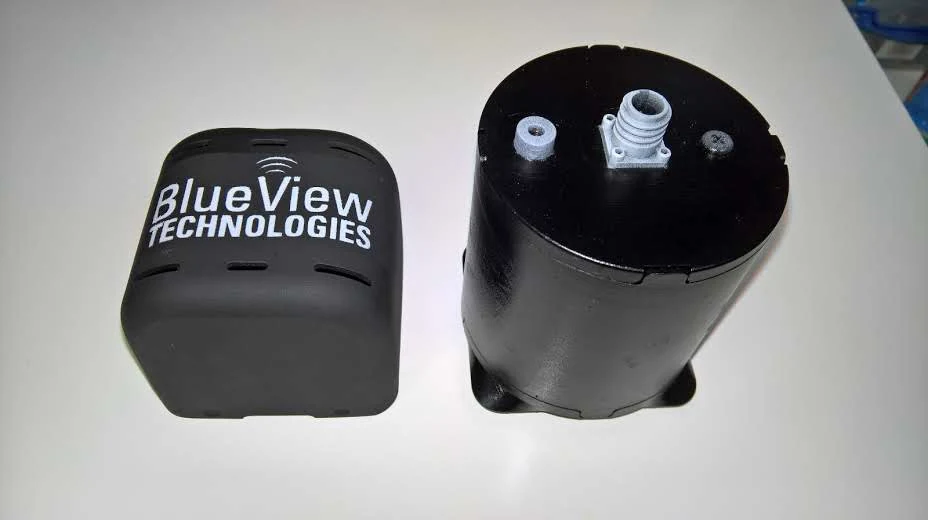
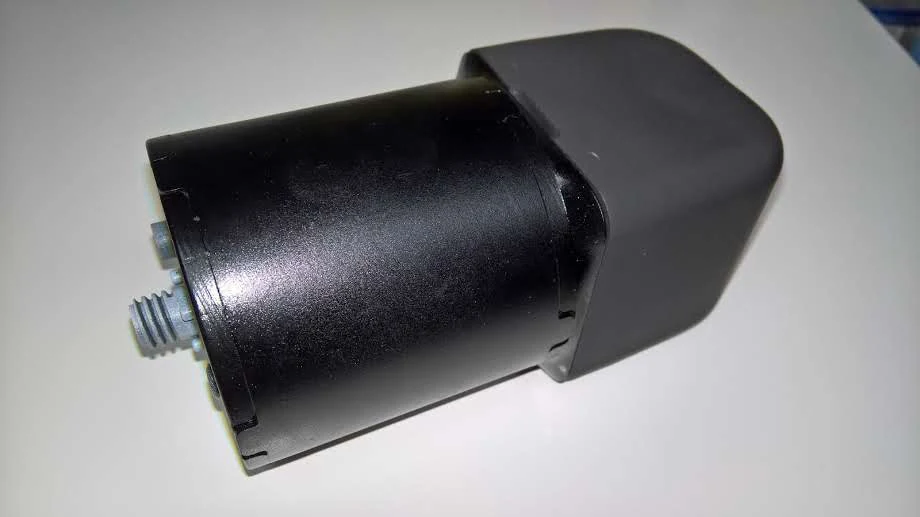
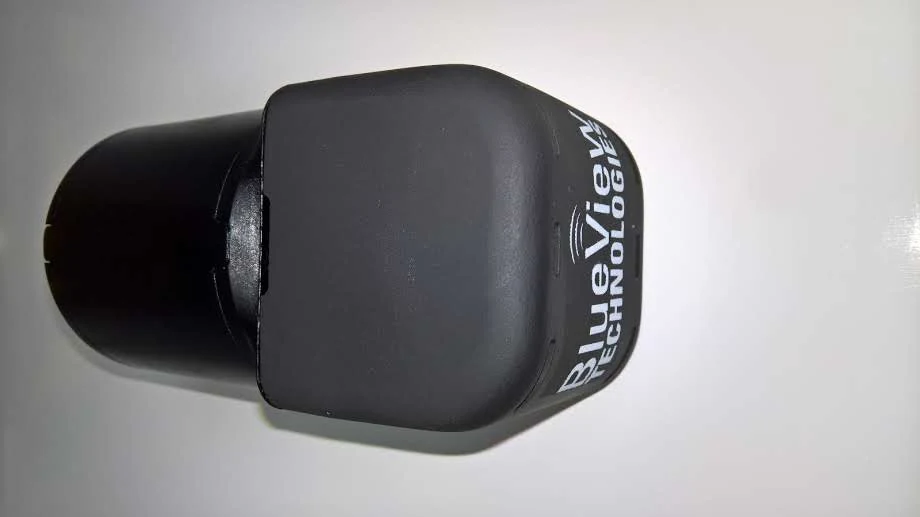
Learn about Teledyne BlueView technology ↗North Sea 3D was approached by a senior representative of Teledyne Marine to produce a full-scale 1:1 replica of the BlueView P900 sonar. The objective was to transform the sonar’s external geometry into a convincing physical representation using additive manufacturing.
Rather than manufacturing an operational sonar, the project demonstrated a different application for industrial 3D printing: producing realistic physical representations of specialist and high-value engineering equipment.
The completed model was produced on a complimentary basis and was very positively received on delivery.
THE CHALLENGE
The model needed to retain the recognisable form and proportions of the P900 while being practical to manufacture using additive processes.
The replica was produced at full size to provide a realistic physical representation of the equipment.
Key external features and proportions needed to reproduce the appearance of the original sonar.
The geometry had to be prepared around the capabilities and build constraints of the additive manufacturing process.
The completed model needed to work as a convincing physical representation rather than simply a rough prototype.
THE SOLUTION
NS3D prepared the P900 geometry for additive manufacture and produced a full-size physical representation of the sonar.
3D printing provided a practical route to creating a complex, recognisable engineering object without the tooling requirements associated with conventional manufacturing.
Full-scale manufacture produced a physically representative 1:1 model.
Complex geometry could be reproduced without dedicated moulds or tooling.
Digital-to-physical production provided a direct route from 3D geometry to a tangible demonstration model.
Low-volume manufacture made a one-off specialist replica commercially practical to produce.
When only one or a small number of physical models are required, additive manufacturing can eliminate the cost and lead time of dedicated production tooling while still reproducing complex engineering geometry.
04 THE RESULT
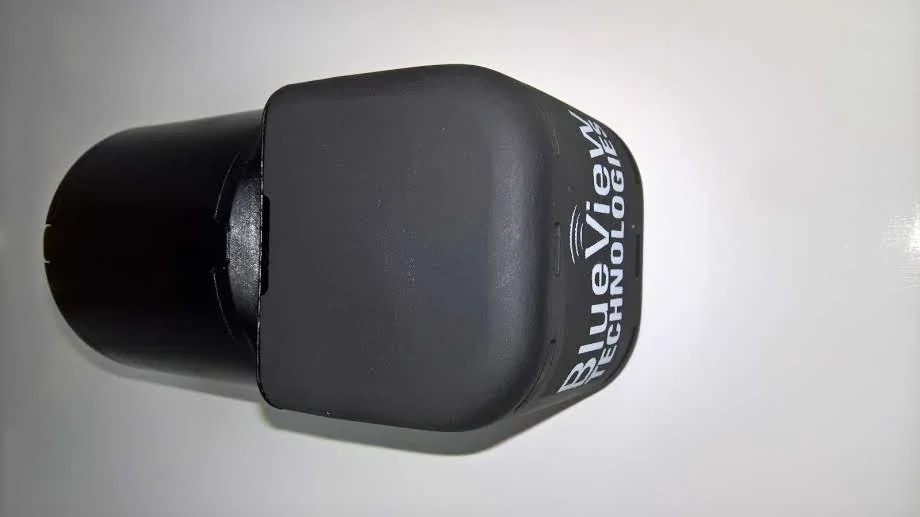
The finished replica demonstrated how additive manufacturing can provide technology companies with realistic physical representations of specialist equipment without using an operational asset.
Full-size output provided a realistic representation of the physical equipment.
The completed model was very positively received by the Teledyne Marine representative who requested it.
The replica was produced without dedicated moulds or conventional production tooling.
A physical replica can provide a practical alternative to handling valuable operational equipment for non-operational purposes.
TECHNOLOGY CONTEXT
Specialist marine and subsea equipment can represent a significant investment and may not always be convenient to transport, allocate or handle purely for demonstration purposes.
Additive manufacturing creates another option. A digital model can be transformed into a full-size physical representation for applications where the appearance, scale and physical presence of the equipment are more important than its operational functionality.
This approach can be particularly useful for manufacturers and technology companies working with complex or high-value equipment.
PROJECT INSIGHT
Additive manufacturing can turn digital engineering geometry into a full-scale physical representation without requiring the real operational asset.
Prototyping is only one application for industrial 3D printing.
For organisations developing sophisticated, valuable or difficult-to-transport technology, additive manufacturing can also provide physical demonstration models, training aids, engineering mock-ups and exhibition pieces.
The P900 replica demonstrates how NS3D can apply additive manufacturing to specialist equipment within industries we support, including marine, subsea, energy and engineering technology.
Geometry and requirements assessed around the intended application.
FDM, SLA and 3D printing material options selected around size, detail and presentation needs.
Physical replicas for demonstration, training and engineering applications.
Tool-free manufacturing makes specialist low-volume projects practical.